
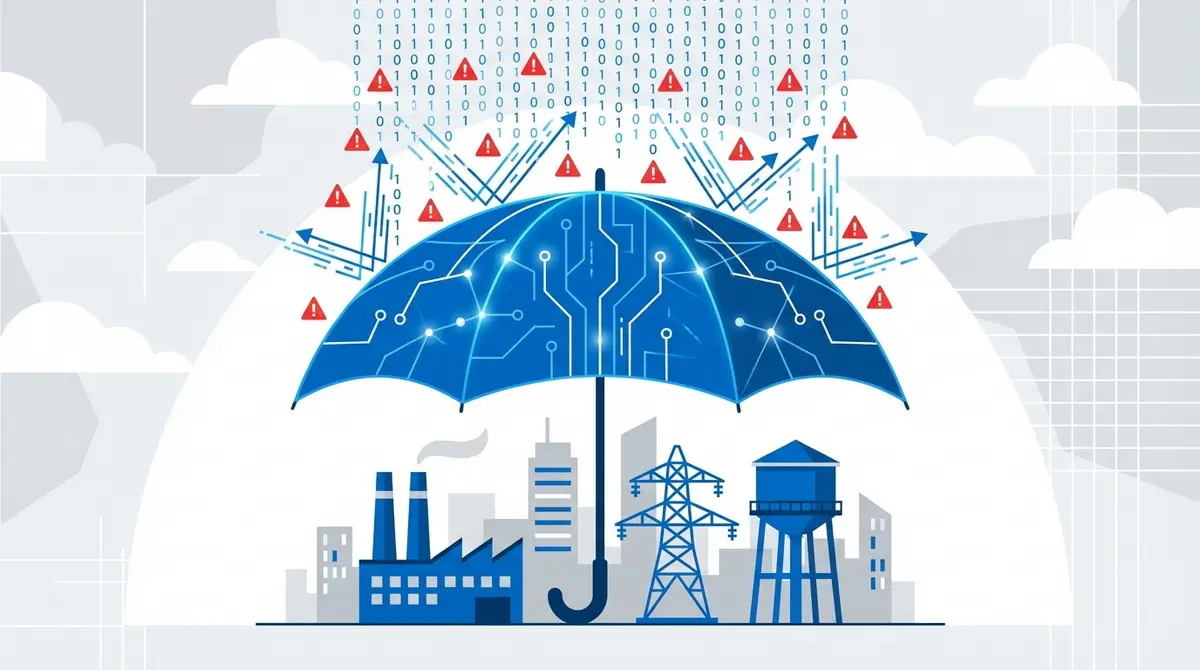
EU 2022/2557 forces 1,700 critical operators to get serious about resilience.
Governments typically move with low urgency, but the threat landscape has finally forced their hand. Enter the KRITIS Umbrella Act, Germany’s answer to EU Directive 2022/2557. It’s not just a fancy name; it’s a mandate obliging about 1,700 operators — from energy to waste disposal — to take security seriously. If you serve more than 500,000 people, congratulations, you’re critical. The days of pleading ignorance or hiding behind a flimsy firewall are over. This legislation demands physical robustness and digital resilience, and quite frankly, it’s about time we stopped trusting ‘air gaps’ that don’t exist.
You Are Critical, Whether You Like It or Not
Congratulations, you’ve just been drafted. With the passing of the KRITIS Umbrella Act and EU Directive 2022/2557, about 1,700 of you are no longer just running a mundane utility; you are officially “critical.” If you provide essential services — energy, water, food, health, or waste disposal — to more than 500,000 people, the government is done asking nicely. You can no longer hide in the shadows of obscurity, hoping that security through obscurity will save you. This legislation tears down the artificial wall between physical security and digital defence, effectively merging the guys with flashlights at the gate with the engineers in the server room.
This is a massive shift in mindset. The law mandates a holistic approach to resilience, acknowledging that a failure in the digital realm usually results in a catastrophe in the physical one. As I discussed in Terminator Becomes National Standard, this mirrors the wake-up call we saw with the updates to NIST SP 800-82. Just as NIST recognised that Operational Technology (OT) now encompasses everything from industrial control systems to building management, the EU is codifying the reality that your digital posture is inextricably linked to public safety. The regulators have finally realised that if a hacker can overheat a turbine or poison a water supply, the distinction between “IT security” and “physical safety” is meaningless.
If you run a facility essential for the survival of half a million people, you can’t just rely on a chain-link fence and a prayer anymore. The Umbrella Act demands that you prove you can take a punch — whether it’s a natural disaster, a cut fibre line, or a ransomware gang — and keep the lights on. You are now required to ditch the plywood defences and treat your infrastructure with the seriousness it deserves because, in this new era, resilience isn’t a “nice-to-have” feature; it’s a legal requirement.
Paper Tigers vs. Real Resilience
Here is the deal with the new legislation: the government identifies the risks, but you are the one on the hook to defend against them. The Umbrella Act demands rigorous risk assessments and immediate resilience measures, but the kicker is the ‘duty to report.’ This isn’t a friendly suggestion; it is a mandate to disclose incidents promptly. It feels a lot like the pressure cooker created by the SEC, where a material breach starts a 96-hour countdown to public confession. As we noted in The 4-Day Warning, trying to perform forensics on a legacy factory floor while the regulator is breathing down your neck is a nightmare scenario.
The real trouble begins when operators try to meet these standards using the traditional ‘castle and moat’ approach. You cannot simply dig a deeper ditch or buy a bigger firewall. Physical barriers and perimeter defences are insufficient when the threat isn’t walking through the front gate — it is riding in on a valid credential or a compromised vendor. Worst of all is the clinging to the ‘air gap’ fairy tale. As discussed in Russian Roulette, assuming your systems are physically isolated is dangerous gambling. In reality, that air gap is riddled with contractor laptops, USB keys, and porous remote access tools. If you build your compliance strategy on the belief that your legacy Operational Technology is invisible to the internet, you are building a paper tiger. The regulators want actual resilience, and plywood patches simply won’t cut it.
Throw Away the Keys and Get an Identity
The regulators have spoken, and for once, the bureaucracy is actually pointing at the right problem. But if you think you can meet these new “resilience” standards with a legacy VPN and a spreadsheet of shared passwords, you are deluding yourself. As we established in Russian Roulette: Gambling with Critical Infrastructure, a VPN is essentially just a very long Ethernet cable that invites the entire internet into your soft, squishy internal network. Once a bad actor breaches that perimeter, lateral movement is trivial.
To actually comply with the Umbrella Act, you need to stop focusing on the “moat” and start obsessing over the “who.” We need to limit the blast radius of an attack, a concept we explored in Krooked Kriminals Krack Krispy Kreme. The solution is a Zero Trust architecture implemented through an Identity-Aware Proxy. Here is the only roadmap that works:
- Identify the User: Kill the shared “operator” accounts immediately. Every human and machine needs a unique corporate identity backed by strong Multi-Factor Authentication (MFA). If you cannot cryptographically prove who is knocking, the door stays shut.
- Authorise Precisely: Stop trusting the network. Just because a contractor is on the Wi-Fi doesn’t mean they should see the turbine controls. Enforce micro-segmentation so users can only touch the specific interface required for their task.
- Secure the Access Path: Decouple authentication from the application. An Identity-Aware Proxy allows you to close all inbound firewall ports, making your infrastructure invisible to the automated scanners that plague legacy setups.
Modernising your identity management is infinitely cheaper — and more effective — than trying to patch a fortress built of plywood. It satisfies the regulator’s demand for robust security and ensures that when the next wave of attacks hits, you aren’t the one filing a breach report.
Conclusions
The KRITIS Umbrella Act isn’t just another bureaucratic hoop; it’s a wake-up call for the backbone of society. Whether you’re managing the power grid or the local dump, the expectation is now explicit: prove you are secure. Hiding behind obscurity or legacy VPNs is a liability you can no longer afford. We need to move past the plywood fortresses and build architecture based on identity and precise authorisation. So, patch your systems, implement real multi-factor authentication, and maybe, just maybe, you’ll survive the next audit without needing a lawyer. Stay safe out there.