
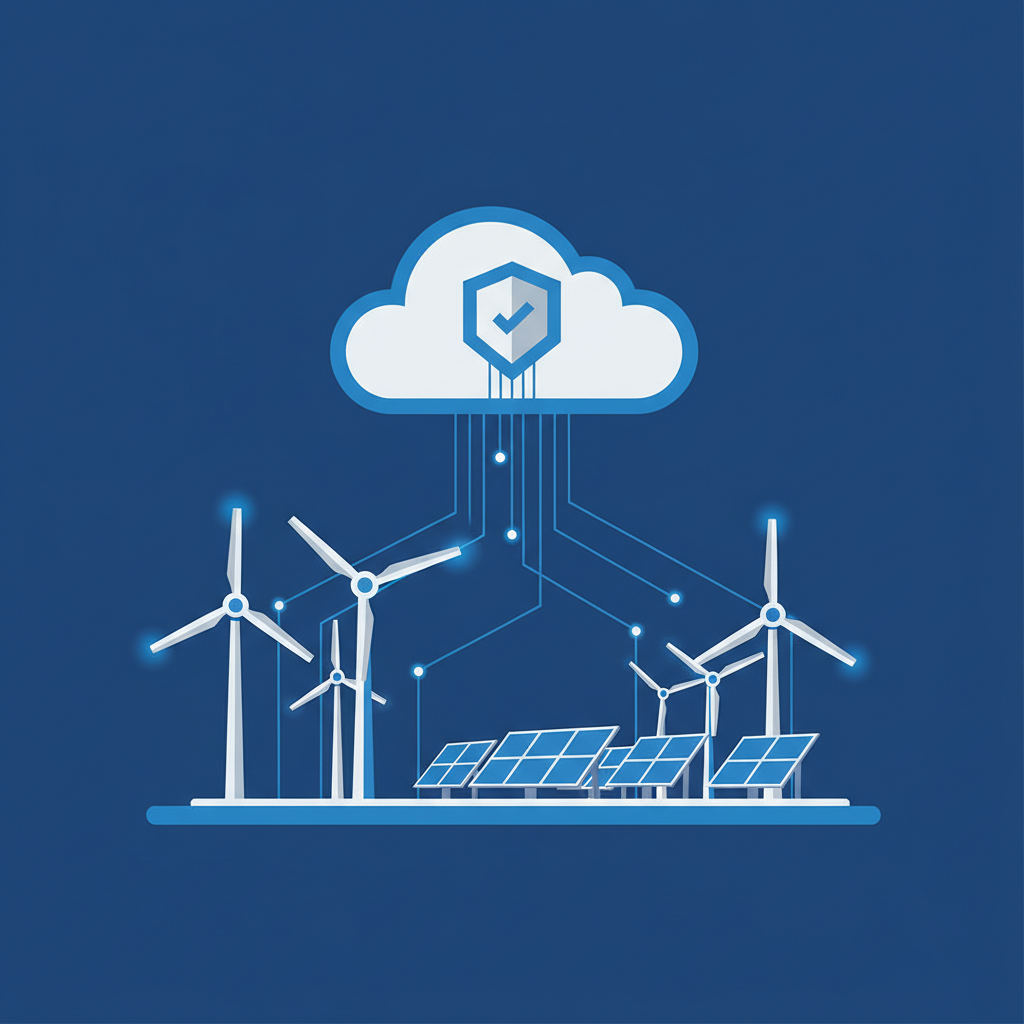
Why wind, solar, and biogas require a rethink of remote access and defence strategies
We are witnessing a massive shift in how we generate power, extending from the industrial behemoths of the past to a constellation of renewable energy sources. It is less about the giant coal plant in the city edge and more about thousands of wind turbines, solar farms, and biogas plants scattered across the rural landscape. But this distributed nature creates a logistical headache. These sites are often miles from fibre optics, relying on Starlink or cellular connections just to phone home. It is like trying to run a high-tech operation using a walkie-talkie; the connectivity challenges are real, and the security implications are even messier.
The Connectivity Headache
Wind turbines and solar arrays are somewhat antisocial; they rarely hang out near the city centre. They reside where the land is cheap, the wind howls, and the neighbours are mostly coyotes. Because these sites are physically isolated, dragging a fibre optic cable out to them is about as economically viable as trying to heat the Atlantic Ocean with a hair dryer. So, operators pivot. They rely on the invisible tether of cellular networks or look to the sky for Low Earth Orbit satellites like Starlink.
But here is where the headache turns into a migraine. These connection types almost universally utilise Carrier-Grade NAT (CGNAT). Unlike a standard business line where you get a nice, static public IP address to hang your hat on, CGNAT groups hundreds of users behind a single public IP managed by the ISP.
Think of it like this: Trying to remote into a device behind CGNAT is like trying to mail a letter to a house that has no street address. You know the house exists, but the only way to reach it is through a PO box that changes location every few hours, and the postmaster refuses to tell you which one it is.
From a networking perspective, this obliterates the ability to use traditional inbound port forwarding or standard VPN setups. The router at the solar farm can talk outbound to the internet, but the internet cannot initiate a conversation inbound because the site is hidden behind the carrier’s massive address translation curtain. The site is technically online, yet completely unreachable by standard means. This architectural blind spot renders the PLC and HMI invisible to the central control room, forcing teams to get creative. Unfortunately, “creative” in networking usually means “complex and fragile,” setting the stage for a chaotic access model.
The Contractor Carousel
Since we have established that getting data out of these sites is a headache, getting people into them — physically or digitally — is an entire migraine of its own. It is economically unfeasible to station a full-time engineer at every solitary wind turbine or solar array scattered across the countryside. Instead, operators rely on a hybrid maintenance model that resembles a revolving door of third-party interaction.
This creates a massive identity crisis. You are dealing with a rotating cast of characters: the original equipment manufacturer updating firmware, a regional managed service provider monitoring uptime, and perhaps a self-employed electrician named Dave who needs to reset a breaker at 3 a.m. These individuals do not belong to a single organisation; they are distinct entities, often without a centralised identity provider.
Because federating identity with a dozen different small businesses is administratively painful, security standards often collapse into the path of least resistance. We see credentials passed around like a hot potato via SMS or sticky notes. The default username and password combinations — the classic admin/admin — are rarely rotated because doing so might lock out the very contractor you need during an emergency.
To bridge the gap between this chaotic workforce and the isolated network, operators frequently deploy “jump boxes.” These are often unmanaged laptops left permanently running inside a dusty cabinet, hosting consumer-grade remote desktop software. It is the digital equivalent of leaving the key to the city under a communal welcome mat; everyone knows it is there, and eventually, someone with ill intent is going to look. This workaround bypasses proper authentication protocols, creating a brittle entry point directly into the sensitive control systems we will discuss next.
Critical Risks in Cornfields
It is unnerving enough to imagine credentials being swapped around like hockey cards in a dressing room, but the anxiety truly spikes when you look at exactly what that messy access connects to. Once a user bypasses that flimsy perimeter, they aren’t landing on a harmless file server; they are interfacing directly with the muscular system of the power grid. We are talking about programmable logic controllers (PLCs), human-machine interfaces (HMIs), and the broader supervisory control and data acquisition (SCADA) systems.
This hardware constitutes Critical Infrastructure, yet it suffers from a distinct lack of digital street smarts. Much of this Operational Technology was designed decades ago for trusted, air-gapped networks — digital walled gardens where every device on the wire was assumed to be friendly. They are essentially promiscuous by design, often lacking basic encryption or authentication capabilities. Exposing these devices to the open internet via cellular or satellite backhaul is akin to leaving your front door wide open in a bad neighbourhood because you assumed you still lived in a quiet cul-de-sac.
The danger is no longer contained to a single site. As renewables shift from being a niche science experiment to a dominant slice of the energy pie, the risk profile changes from isolated to systemic. In the old days, if a single substation failed, it was a local nuisance. Today, immense fleets of solar inverters and wind turbines often run identical firmware and controllers. This creates a technological monoculture. A vulnerability in one specific type of controller isn’t just an isolated incident; it provides a blueprint to attack thousands of distributed sites simultaneously.
If a threat actor compromises a single coal plant, the grid adjusts. If they simultaneously command ten thousand solar inverters to shut down or inject bad frequency data, the grid collapses. It is the terrifying difference between a single blown fuse and a neighbourhood blackout. The sheer surface area of these distributed endpoints means we can no longer rely on the perimeter for safety; we need a strategy that assumes the network itself is already hostile.
Zero Trust as the Defence
The solution isn’t to build higher walls around the cornfield; it is to treat every user like a stranger until proven otherwise. This is where Zero Trust enters the chat, serving as the cornerstone of a modern defence in depth strategy. Rather than relying on a VPN — which essentially digs a tunnel under your fortress wall and hopes nobody evil crawls through it — Zero Trust assumes the network is already hostile.
This architecture elegantly sidesteps the connectivity nightmare mentioned earlier. Since satellite and cellular carriers rely on Carrier Grade NAT (making traditional port forwarding impossible), Zero Trust relies on outbound-only connections. The renewable site reaches out to a secure cloud broker, establishing a link without ever opening a listening port to the public internet. It is the digital equivalent of a submarine that only communicates when it decides to surface; if hackers scan the IP address, they see absolutely nothing.
This approach also tidies up the messy reality of third-party access. Instead of handing out the keys to the kingdom via shared passwords, operators can enforce unified authentication. A specific contractor gets granular access to a single programmable logic controller or HMI for a set timeframe, authenticated via their own corporate identity and multi-factor authentication.
Ultimately, this isn’t just about keeping the bad guys out; it is a calculation of efficiency. When access is secure and seamless, operators stop hesitating to perform remote maintenance. This means fewer physical truck rolls to remote sites, faster response times to inverter faults, and higher uptime. It turns security from a roadblock into an enabler, ensuring the lights stay on without burning through the maintenance budget.
Conclusions
As we transition to a greener grid, we cannot afford to use rusty security practices. The unique combination of remote locations, satellite connectivity, and a revolving door of contractors makes traditional VPNs and perimeter defences obsolete. We need a strategy that acknowledges the reality of the field: the network is untrusted, and the stakes are high. By adopting Zero Trust and unified authentication, organisations can secure these critical assets without hindering the third parties who keep them running. It is about ensuring that our sustainable future is also a secure one.