
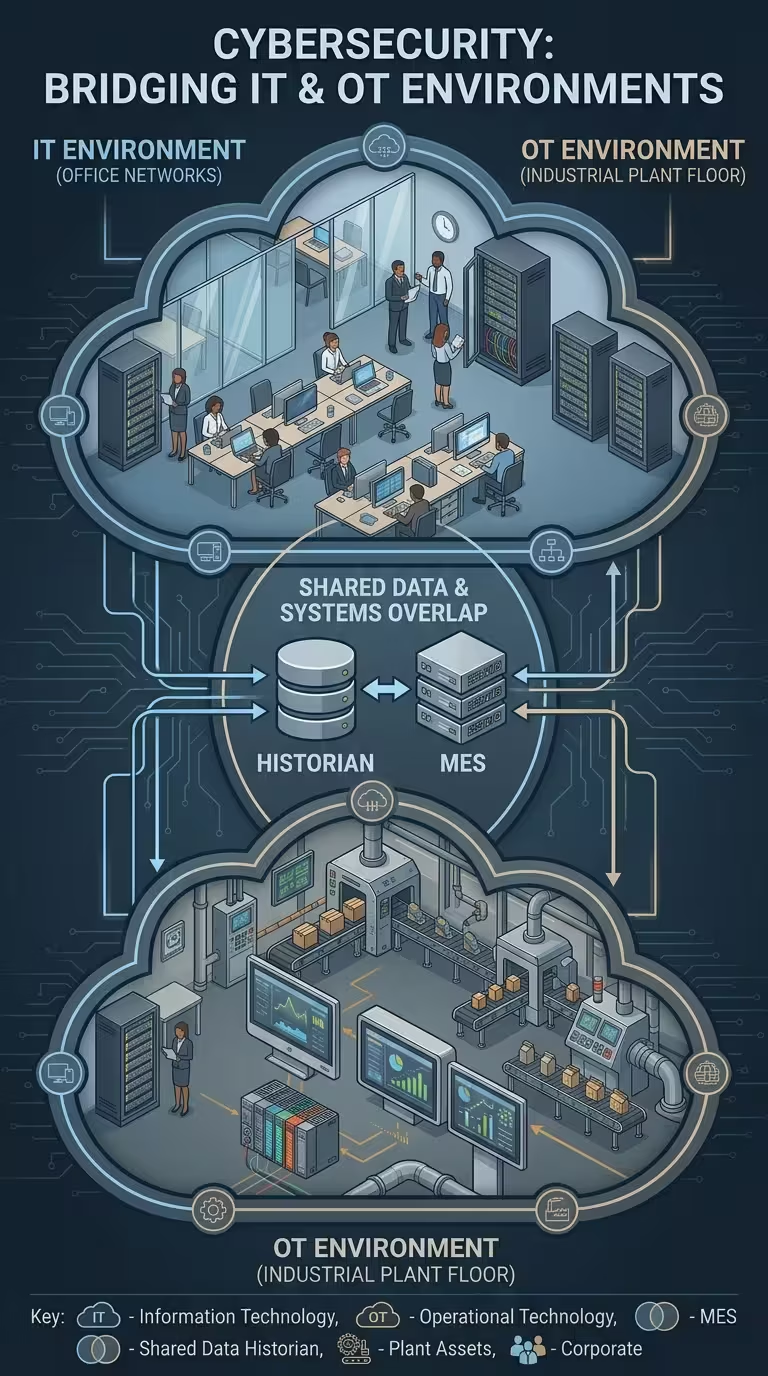
For too long, Operational Technology has been treated as a mysterious, untouchable snowflake, supposedly protected by the legendary and impenetrable “air gap.” The reality, however, is that modern industrial environments are highly interconnected, hybrid networks where corporate IT seamlessly blends with plant floor machinery. When we rely solely on an antiquated perimeter defence, we leave critical infrastructure dangerously exposed to modern threat actors, supply chain vulnerabilities, and simple human error. To meaningfully de-risk operational technology at a reasonable cost, organisations must abandon the illusion of a perfect air gap and instead invest in a pragmatic, multi-dimensional defence-in-depth strategy that actively controls system vulnerabilities.
Related Reading
Simple 3-Step Program To Reduce The Risk Of Ransomware
The inherent flaw of the air gap is that it assumes a binary world of “outside bad, inside good,” completely ignoring insider threats, compromised vendor laptops, or a malicious USB drive plugged directly into a SCADA workstation machine. Risk is ultimately an equation: Risk = Threat × Vulnerability × Impact. While you cannot always control the sophistication of the adversary (the threat) or the catastrophic cost of physical downtime (the impact), you have absolute control over your vulnerabilities. Relying on a single boundary is like holding up a single sheet of paper to stop an attack; when that layer fails, as historical compromises like Stuxnet and recent attacks on electrical grids have proven, the entire system falls.
Effective security requires independent, orthogonal layers of defence, a concept perfectly illustrated by the “Swiss Cheese Model.” In this model, every defensive layer has inherent flaws or “holes,” but by stacking multiple, uncorrelated control mechanisms, you ensure a single point of failure does not cascade into a total systemic breach. If an adversary bypasses a network firewall, they should immediately hit a completely unrelated barrier, such as an identity check or an internal micro-segmentation rule. By categorising your environment pragmatically: recognising that much of your operational technology is simply standard IT hardware sitting in a different building, you can apply appropriate patching, hardening, and lateral movement restrictions to contain potential breaches without disrupting the core industrial process.
To achieve this resilience, organisations should focus their investments across five distinct, independent dimensions: Boundary Defence, Identity & Credentials, Lateral Movement, System Hardening, and Visibility & Detection. Upgrading just one of these exponentially improves the overall strength of your network. For instance, CISA’s Risk and Vulnerability Assessments (RVAs) consistently highlight that identity and credential abuse is a primary vector for successful cyberattacks. By implementing phishing-resistant multi-factor authentication (MFA) and eliminating shared vendor accounts, you neutralise this massive threat. Combine this identity-first approach with strict boundary enforcement, internal protocols to block lateral movement, rigorous system hardening, and deep centralised logging, and you buy your team the precious time needed to detect and stop an intrusion.
Securing operational technology infrastructure doesn’t demand an infinite budget, nor does it require paralyzing the business in pursuit of “zero risk”; it simply requires a layered, multidimensional approach that systematically mitigates vulnerability. Every incremental improvement across these five independent dimensions drastically reduces your operational risk, proving that the enemy of “good enough” is perfection. You don’t have to tackle the entire environment overnight. To help you chart a pragmatic course forward, Agilicus has developed a free Cyber Security Assessment Scorecard and a detailed Industrial Cyber Security Best Practices Guide. I invite you to use these tools to evaluate your current posture, identify your most critical gaps, and begin making targeted security investments that deliver true operational resilience.