
Overview
It used to be that the factory floor and the stock market regulators were worlds apart, like distant cousins who only met at awkward family reunions. That has changed. The U.S. Securities and Exchange Commission (SEC) has dropped a new set of rules that act like a splash of cold water to the face of public companies. Specifically, if you experience a ‘material’ cybersecurity incident, you now have a mere four business days to tell the world about it via Form 8-K. For the manufacturing sector, where legacy industrial control systems often hum along in obscurity, this brings a level of scrutiny that many are simply not prepared to handle. It is time to look at what this means for your defence strategy.
The Four Day Dash and the Materiality Muddle
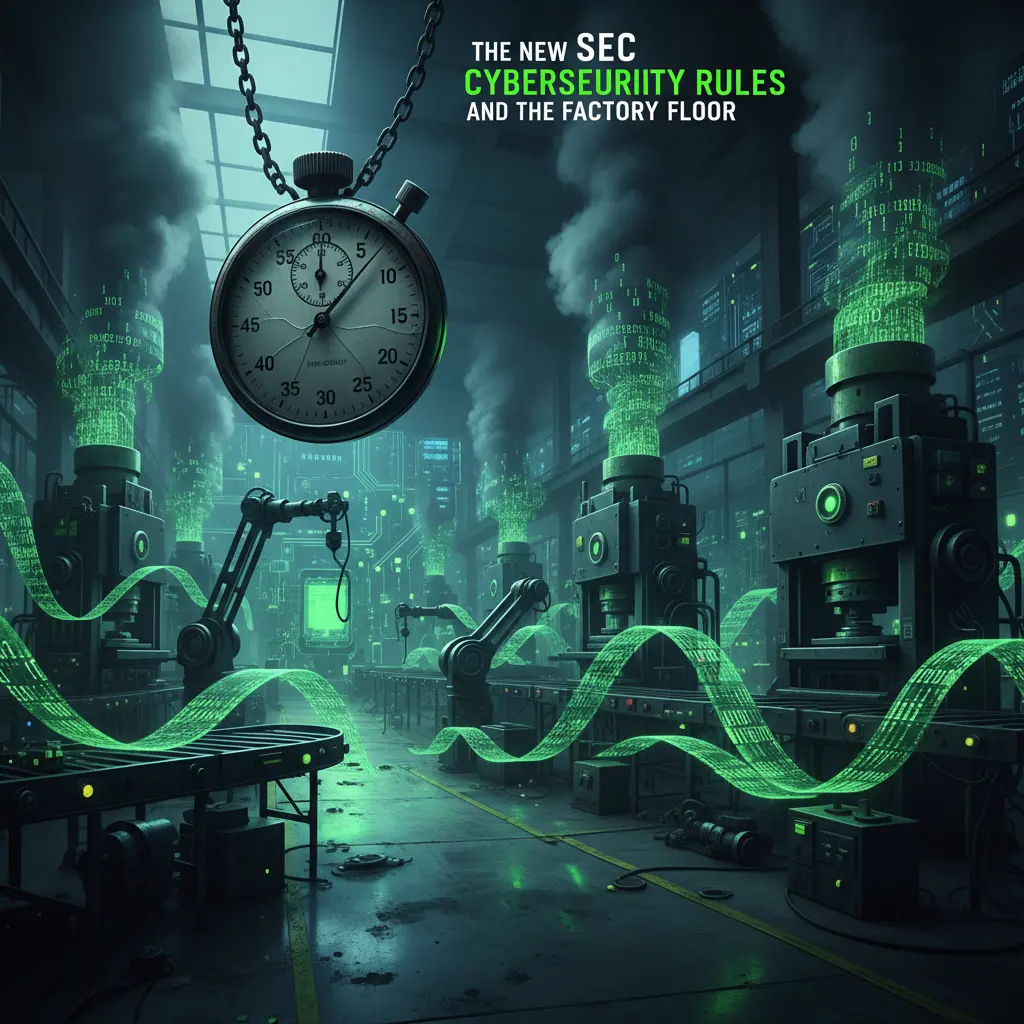
Picture the frantic energy of a tied basketball game in the fourth quarter. The referee hands the ball to the point guard, and that big, red LED shot clock immediately starts counting down. You do not have time to convene a committee to discuss the theoretical physics of the ball’s arc; you have to execute the play. Under the new U.S. Securities and Exchange Commission (SEC) rules, once your organisation determines a cybersecurity incident is material, that shot clock starts ticking. You have exactly four business days to file a Form 8-K.
This isn’t a polite request for a status update. The Form 8-K is the permanent record of corporate events that shareholders need to know about. Previously, companies might have waited weeks or even months to disclose a breach, often hiding behind ongoing forensic investigations. That era is over. Now, the moment you make the judgement call that an incident matters, the 96-hour countdown begins. And no, you cannot wait until your investigation is complete. The rules explicitly state that the deadline must be met even if some information is unavailable, requiring you to file an amended Form 8-K later when the full picture comes into focus.
This brings us to the murky concept of materiality. In the world of bits and bytes, we tend to measure severity by data volume or privilege escalation. But the SEC doesn’t care about your SQL injection logs; they care about the bottom line. A ‘material’ incident is one that a reasonable investor would consider important in making an investment decision. It is a financial and operational standard, not a purely technical one.
This definition creates a massive grey area for industrial organisations. It implies that you must look beyond data theft and assess:
- Operational disruption: Did the attack force you to shut down a revenue-generating production line?
- Brand defence: Will this erode customer trust to the point of impacting future contracts?
- Legal liability: Are you facing lawsuits that could bleed the treasury?
There is one potential timeout available, but don’t count on it. The rules provide a mechanism for delaying the filing if the United States Attorney General determines that immediate disclosure would pose a substantial risk to national security or public safety. However, treating this provision as a standard operating procedure would be a mistake. This is a rare ‘get out of jail free’ card, likely reserved for state-sponsored attacks on critical infrastructure or events that threaten human life. Unless your manufacturing plant is building components for the next generation of fighter jets, getting the Attorney General on the phone to pause your shot clock is technically possible, but statistically improbable. For Foreign Private Issuers (FPIs), the burden is similar, requiring them to furnish information on Form 6-K regarding material incidents disclosed in other jurisdictions.
The pressure creates a frantic relay race between the technical teams discovering the issue and the legal teams interpreting it. But unlike a standard IT breach, where the damage is often contained to servers and spreadsheets, the situation becomes infinitely more complex when the incident originates in the operational technology environment.
When the Factory Floor Meets the Filing Cabinet
So, the lawyers know the clock is running. But down on the plant floor, things get significantly muddier. There is a historic, almost geological disconnect between the corporate compliance teams polishing their penny loafers in the boardroom and the operational technology teams keeping the lights on. In a standard IT environment, a breach is usually about data extraction–someone stole the customer list or the secret sauce recipe. You trace the IP address, you patch the server, you move on.
But when a threat actor pivots into the industrial control systems, we aren’t dealing with hypotheticals or intellectual property anymore; we are dealing with kinetic physics. A compromised programmable logic controller doesn’t just leak data; it changes the physical behaviour of a machine. This brings us to the thorny requirement of disclosing the “nature, scope, and timing” of an incident. That sounds reasonable to a regulator in Washington, but it is a nightmare for an engineer trying to extract a timestamped event log from a lathe running on an operating system that hasn’t been patched since the release of the first Shrek movie.
Unlike an email server, an attack on the manufacturing line results in tangible chaos that is difficult to quantify for a Form 8-K in under four days. You are looking at real-world consequences:
- Physical spoilage: If a temperature sensor is manipulated in a pharmaceutical or food processing plant, entire batches must be scrapped, costing millions in wasted raw materials.
- Safety overrides: Cyber incidents can disable the safety instrumented systems that prevent pressure vessels from becoming improvised bombs, creating a life-safety issue that is instantly material.
- Supply chain dominoes: A halted line means missed delivery windows for Just-in-Time partners, triggering contractual penalties that might arguably be “material” immediately.
Here lies the rub. How does an organisation decide, with legal certainty, that a glitch in the assembly line is a material cyber incident and not just a mechanical failure, all within that 96-hour window? If the robotic arm stops responding, is it a bad actuator, or has a foreign adversary rewritten the ladder logic? Most legacy environments lack the modern logging capabilities to answer that question quickly. You are essentially asked to perform a forensic autopsy on a patient that is still trying to run a marathon. The compliance team needs a definitive “yes” or “no” on materiality to satisfy the SEC, but the operational technology team is often staring into a black box, trying to prove a negative without the necessary telemetry.
Polishing Your Armour and Prep Work
Now that we have established that your thirty-year-old conveyor belt controller does not exactly speak the same language as a corporate lawyer, how do you bridge that gap before the four-day timer runs out? You simply cannot disclose what you do not see. Attempting to define the nature, scope, and timing of an attack without deep insight into your industrial environment is like trying to describe the colour of a cat in a pitch-black room–you are just guessing, and the Securities and Exchange Commission generally does not appreciate guessing games.
Prioritise deep visibility above all else. If your operational technology data is siloed away from the rest of your digital defence infrastructure, you are fighting with one hand tied behind your back. You must integrate operational technology data into your broader security operations centre. The goal is to provide your analysts with a unified view where a suspicious command sent to a programmable logic controller correlates with an alert in the corporate network. If the folks monitoring the screens cannot see the factory floor, they cannot assess if an incident is material, let alone report it within 96 hours.
However, seeing the threat is only half the battle; reacting to it requires a cast of characters that extends far beyond the engineering department. In the past, an industrial snag was strictly the domain of plant managers and technicians. That era is over. You must rewrite your incident response plans to include legal counsel and communications teams. These non-technical stakeholders need to understand the nuances of a distributed control system failure so they can draft that Form 8-K accurately. They cannot be learning what a historian server is while the clock is ticking down.
Think of this process like a fire drill in a crowded theatre. When the alarm sounds, you do not want the audience panicking and shoving against a locked door because nobody checked if it opened. You want a well-rehearsed exit strategy where everyone–from the shift supervisor to the Chief Legal Officer–knows exactly which exit to take. Conduct regular tabletop exercises that simulate a material event to ensure the workflow between detection, assessment, and disclosure is seamless. Ultimately, this preparation is not merely about avoiding regulatory fines or satisfying a government agency. It is about operational resilience. By polishing your armour now, you ensure that when the hit comes, your organisation does not just file the right paperwork, but actually survives the blow.
Conclusions
The new SEC mandates are more than just another hoop to jump through; they are a signal that cybersecurity is now a core component of corporate integrity. For manufacturers, the challenge is double-edged: you must defend legacy infrastructure while being ready to publicly detail your failures in near real-time. It is a bit like being asked to fix a leaky pipe while a news crew films your plumbing skills. The four-day window does not allow for hesitation. Organisations must bridge the gap between their operational technology and their legal reporting mechanisms now, because once the clock starts ticking, it is already too late to start introduction introductions.