
Why your bus drivers, lifeguards, and contractors are stuck in the analog age, and why it’s a security dumpster fire.
Let’s be honest. You have a caste system in your organisation. On one side, the ‘knowledge workers’ with their shiny corporate laptops, VPNs, and Single Sign-On. On the other? The bus drivers, the lifeguards, the HVAC contractors. They get paper forms, shared kiosks, and post-it note passwords. You’ve been told this is inevitable. That securing a personal iPad or a contractor’s Android phone is a ‘risk’ your delicate network can’t handle. Rubbish. It’s not a technical limitation; it’s a failure of imagination. By disenfranchising these users, you aren’t just hurting productivity; you’re creating a shadow IT nightmare where data leaks happen because you made the safe way impossible.
The Great Divide Between Suites and Streets
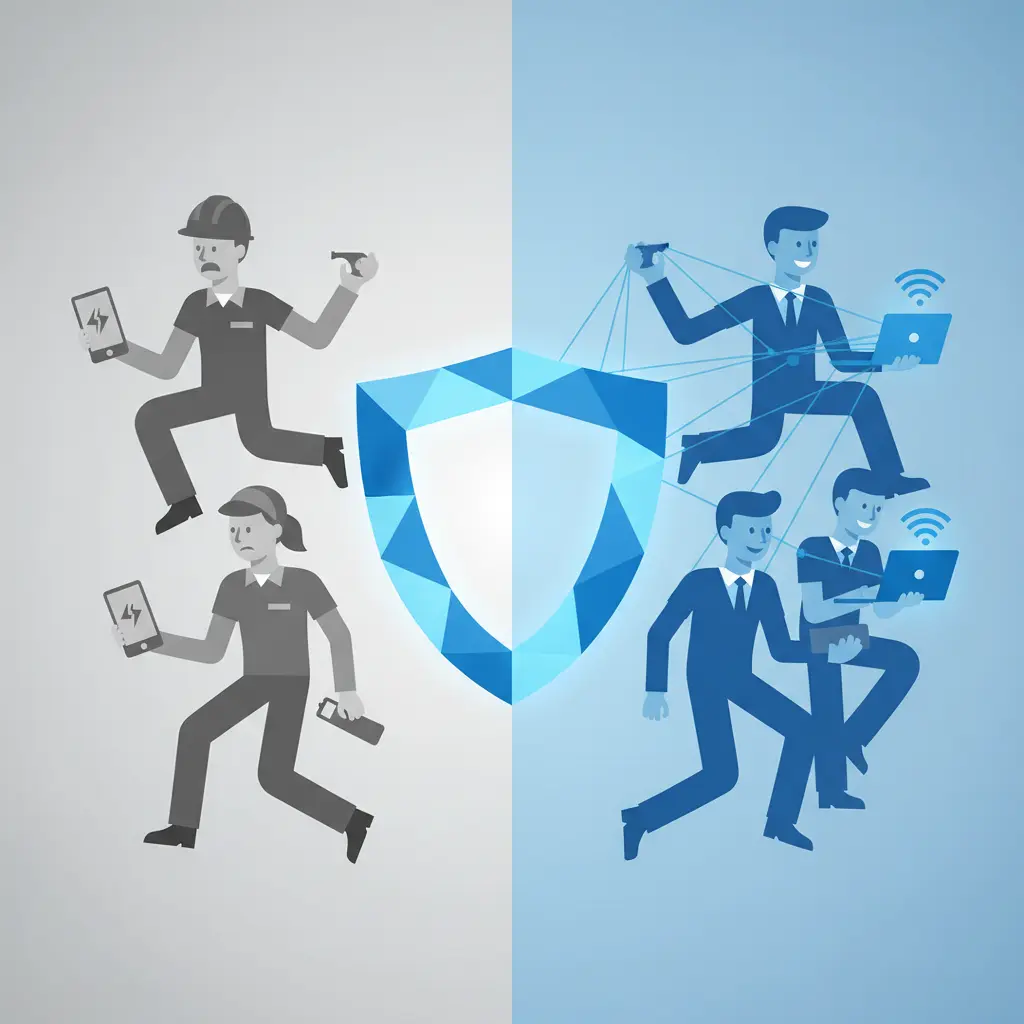
Imagine a medieval fortress. Inside the keep, the nobility — your desk-based staff — enjoy the protection of high walls, armed with keys to every room. Outside? The peasants — your bus drivers, lifeguards, and HVAC contractors — are left mucking about in the mud, shouting over the ramparts just to get a shift change approved. This is the **digital disenfranchisement** facing your frontline workforce today.
IT departments have historically ignored these users for a simple, lazy reason: they do not fit the “standard model.” They do not have Active Directory accounts, and they certainly do not have corporate-issued laptops. Instead, we force them into **productivity-killing shenanigans** like paper timesheets or, worse, shared kiosk computers that are a petri dish for germs and credential theft.
Why does this happen? Because your legacy perimeter security — those precious firewalls and VPNs — are too expensive and clunky to scale. You cannot justify a $2,000 laptop and a complex VPN license for a summer student or a third-party vendor. As noted in Zero Trust: Connecting The Digitally Disconnected, relying on shared kiosks is impractical, yet organisations persist because they believe the lie that security requires ownership.
I am here to tell you that this is an artificial barrier. With Agilicus AnyX, we flip the script. We allow any user, on any device, to use any application. By utilising federated authentication — letting them sign in with their own Gmail or a partner organisation’s credentials — you remove the friction of managing thousands of temporary accounts. You can grant secure, granular access to a bylaw officer on their personal iPad without reducing your security posture. It is time to stop treating your most essential workers like second-class citizens and dismantle the castle walls.
The Lie You Have Been Sold About Security
You have been gaslit. For decades, the security industry — and I’m including myself in this — sold you a convenient myth: that to be secure, you must own the hardware. We told you that if you didn’t issue the laptop, you couldn’t trust the packet. This is absolute nonsense designed to sell more hardware and managed services.
Let’s talk about your “Air Gap.” It’s a lie. Unless your server is at the bottom of the Mariana Trench encased in concrete, it’s connected to something. Relying on a perimeter firewall to protect your soft, gooey centre is like building a bank vault out of plywood. It looks sturdy from the street, but it won’t stop anyone with a crowbar and five minutes of determination.
And your current solution for the remote folks? The Virtual Private Network. Let’s be blunt: VPNs are a security dumpster fire. They provide a tunnel right past your plywood vault, granting an IP address that allows for unchecked lateral movement. Once a bad actor — or a confused contractor — is inside, the blast radius is effectively your entire subnet. You are handing the keys to the castle to someone who just needs to fix the ice rink lighting.
The truth is, Bring Your Own Device (BYOD) isn’t the unmanageable risk you’ve been warned about. As we outline in Bring Your Own Device in Agilicus AnyX, the device is irrelevant if you stop blindly trusting the network. We need to abandon the fallacy of the “secure wire.” With Agilicus AnyX, we don’t care if your bus driver is using a dusty iPad or a gaming PC. We care about who they are. It is time to trust the Identity, not the plastic casing of the laptop.
Identity is the New Perimeter
So, we’ve established that VPNs are a disaster and shipping corporate laptops to seasonal staff is burning money. What’s the fix? It is treating Identity as the New Perimeter. We need to stop obsessing over where the user is sitting — because let’s face it, the “inside” of your network is already porous — and start obsessing over who they are.
Enter Agilicus AnyX. It functions as an Identity-Aware Proxy. Think of it less like a network tunnel and more like a very suspicious, very intelligent nightclub bouncer. It stands between the wild internet and your precious internal applications. It allows your bus drivers, contractors, and lifeguards to sign in with the credentials they actually know and use — like their personal Gmail or their agency’s Microsoft account — to access your internal apps securely.
Here is why this stops the security dumpster fire:
- No client software to install: It is entirely clientless. If they have a web browser, they are operational. No fighting with VPN agents or trying to force MDM profiles onto a teenager’s personal iPhone.
- Precise Authorisation: We use Role-Based Access Control (RBAC). The user gets a key to a specific safety deposit box, not the master key to the bank. You define exactly which resources they can touch.
- Full Auditability: You get a complete log of exactly who accessed what and when. No more guessing which mystery IP address started the shenanigans.
This approach democratises access. Your summer lifeguard gets the exact same secure, high-quality experience as your CEO. The only difference is the permissions policy attached to their identity. And here is the kicker: because we are not bridging networks at the packet level, we remove the friction of onward risk. If that lifeguard’s phone gets pwned, the bad actor sees a swimming schedule. They don’t get a route to your domain controller or a chance to move laterally. You have finally killed the blast radius.
Conclusions
The digitally disenfranchised aren’t a lost cause; they are an untapped resource. We have the technology to fix this. It’s called Zero Trust, and it works without the bloat of VPNs or the cost of shipping laptops to summer students. Stop accepting the lie that this is hard. It’s time to level the playing field, secure your perimeter by shrinking the blast radius, and let people do their jobs. Band together, fix the problem, and maybe, just maybe, your HVAC guy won’t have to drive on-site just to check a thermostat. Fix the access, fix the equity, and secure the unexpected.